The Whisper Man rhyme
The Whisper ManThe Whisper Man rhyme is a four-line warning verse that gives the Whisper Man a memorable language and allows fear of him to travel beyond the original crimes. Its structure joins domestic precautions, isolation, and emotional vulnerability: an open door leads to whispers, solitary play to disappearance, an unlatched window to tapping, and loneliness to the Whisper Man's arrival. What begins as advice for children therefore becomes both a protective ritual and a lasting record of Featherbank's fear.
Form and Warning Structure
The rhyme is built from four conditional warnings. Its opening couplet states, "If you leave a door half open, soon you’ll hear the whispers spoken." The next lines extend the danger outward: "If you play outside alone, soon you won’t be going home" and "If your window’s left unlatched, you’ll hear him tapping at the glass." The final line moves from physical exposure to inward distress: "If you’re lonely, sad, and blue, the Whisper Man will come for you." Each line has the compactness and cadence of a playground saying, while its sequence steadily narrows the child's safe world—from doors and windows, to the outdoors, and finally to the child's own feelings.
The verse works as a rule of behavior because every threat is attached to a recognizable failure of protection. A door must be closed, a window latched, and a child must not play outside alone. The rhyme does not offer an abstract warning about evil; it supplies a series of actions that can supposedly prevent it. Its repeated "If" creates a conditional logic in which safety appears controllable, even though the last line makes clear that the threat can reach a child through sadness and loneliness as well as through an unlocked entrance.
Oral Transmission and Childhood Culture
The rhyme is explicitly explained as something children used to say in the playground. When a child asks what it means, the answer describes it as a warning, but also as "just good advice" in a world containing many bad people and bad things. That double description matters: the verse can pass as harmless folk wisdom while carrying the memory of a specific predator. Its childish rhythm makes the material repeatable, and repetition allows the fear to survive without requiring children to know every detail of the crimes behind it.
The rhyme is consequently less a fixed statement than a piece of local oral tradition. It is remembered by adults as something heard in childhood, repeated by children who may know it only as a common saying, and recognized imperfectly by people who wonder whether it came from a television program or some other part of children's culture. Its apparent familiarity can conceal its disturbing origin. The more ordinary it sounds, the more effectively it allows the Whisper Man to become part of everyday childhood speech.
Use in the Plot
The rhyme becomes significant when Jake Kennedy begins saying it before his first day at school. Tom Kennedy recognizes the words as strange because they occur outside the playground context in which he expects such a saying to belong. Karen Shaw thinks she has heard the opening before and identifies it as the sort of rhyme children might repeat at school, but that explanation does not resolve why Jake knows it at that moment. The gap between the rhyme's ordinary social explanation and its ominous timing makes it an early sign that the child is connected to a danger the adults have not yet understood.
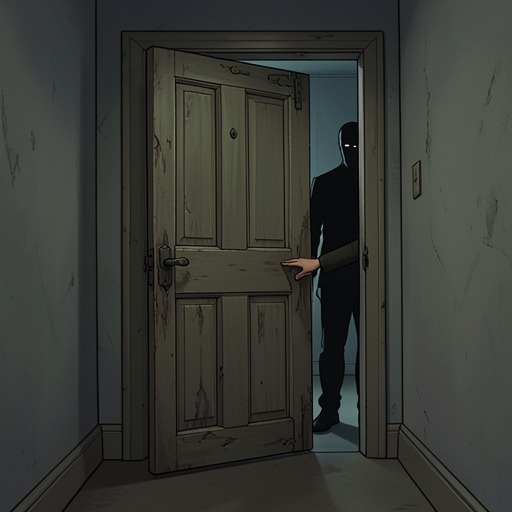
The verse also accompanies acts of ritual. One scene states that the Whisper Man performs the ritual before what follows, while the rhyme itself teaches that doors must be closed. The rule thus operates in two directions: children are told to protect themselves by controlling thresholds, and the threatening figure's presence is associated with the same threshold imagery. The half-open door is not merely a household detail. It becomes a boundary left vulnerable, a visual and practical form of uncertainty through which whispers may enter.
Tom later reads about Carter and the Whisper Man and finds the details horrific. At that point, the rhyme is no longer only a playground fragment; it is attached to an adult criminal history. The discovery changes its emotional register without changing its wording. The familiar lines become a compressed version of the threat's method, translating terrible knowledge into language children can remember.
Written Memory and Family Inheritance
The rhyme receives its most revealing written form in a much older sheet of paper torn from a small ring-bound notebook. Tom recognizes Rebecca's handwriting and infers from the faded ink that she wrote the poem as a teenager. This document establishes that the verse predates its later appearance in the family's immediate crisis and links Rebecca's private youth to the wider culture of fear surrounding the Whisper Man. The rhyme is therefore not simply something Jake has picked up recently; it is also preserved as an artifact of an earlier generation.
The notebook page changes the rhyme from a sound heard in passing into an object that can be kept, rediscovered, and reinterpreted. Its frayed edge and faded ink give the words a material history, while the repeated four lines create continuity between Rebecca's adolescence, Jake's speech, and the adults' later investigation. The family does not inherit only information about a criminal case. It inherits a form of language in which danger, separation, and loneliness have already been arranged into memorable patterns.
Meaning and Narrative Significance
The rhyme's deepest force comes from the tension between protection and blame. It tells children to close doors, latch windows, and avoid solitude, offering practical actions against an apparently external threat. Yet its final warning makes loneliness itself dangerous. The verse can therefore comfort by giving rules, while also burdening vulnerable children with the implication that failing to follow those rules helped invite harm.
Its recurrence gives the novel a circular quality. The words move from childhood speech to adult recollection, from Jake's unsettling repetition to Rebecca's faded handwriting, and from the story of the Whisper Man back into family memory. Near the end, a sense arises that a cycle has been completed or something found, and the rhyme participates in that pattern of return. It does not solve the mystery by supernatural means; instead, it records how a human crime becomes a communal legend and how that legend continues to shape the people who remember it.
The rhyme also changes the meaning of the Whisper Man's name. The figure is not defined only by acts of violence but by the whispered language that surrounds those acts. The verse makes fear portable: a child can carry it into a bedroom, a playground, an unlocked window, or a moment of sadness. In this form, the Whisper Man remains present even when no physical figure is visible. The rhyme is thus both warning and evidence—a small piece of folk language that preserves the reach of the crime across places, ages, and generations.